Showing posts with label games. Show all posts

Tuesday, January 17, 2012

Waldorf Techniques for Mastering Math Facts with Body Movements that Anyone Can Use

by Kathy Stemke

Waldorf education’s interdisciplinary learning is based upon the educational philosophy of Rudolf Steiner. Since the first school opened its doors in 1919, this style of learning has concentrated on the role of imagination to integrate practical, creative and conceptual elements. In addition to the 994 independent Waldorf schools, there are many Waldorf-based public schools and homeschooling situations. In fact, most schools use some of the innovative Waldorf activities in their curriculum.

Because math concepts tend to be abstract in nature and the traditional methods of teaching math facts are boring and ineffective, introducing Waldorf interactive math activities into the classroom will increase the learning and retention of math facts. Students will be eager to participate in these fun-filled games and projects.

COUNTING GAME

A counting lesson might begin with a circle game similar to Duck-Duck-Goose. The students sit in a circle on the floor then one students stands behind a sitting classmate and begins counting each of their classmates in turn until they reach ten. All the students can assist in the counting. When the standing student reaches their tenth classmate the tenth classmates stands and chases the counting student around the circle attempting to tag them before they return to the place of the chasing student.

JELLYBEAN STORY

Students learn through exciting fairy tales and stories. Fun characters come to life for the students, bringing the numbers and math facts to the real world. The following tale is an example of the kind of story that can be used.

“It’s my job, said the jellybean queen, to divide the jellybeans equally among the subjects of Numeria. This bag of jellybeans is for you two girls. Be sure to share them equally.”

“But how can we be sure to share them equally between us?” Chali asked.

“Oh,” the kindly queen said, “That is easily accomplished. Watch. . . . There are six jellybeans in the sack . . . .here is one for you, Chali, and one for you Stephanie, another one for you Chali, and another one for you Stephanie, one more for you Chali, and one more for you Stephanie . . . as you see we now have two piles of jellybeans with 3 in each. It’s as simple as that!” The girls smiled at each other.

The queen was so busy she asked the girls to help her. For the rest of the day, Chali and Stephanie busily counted and divided jellybeans."

This story could easily be modified to teach subtraction. The students could take turns eating one or two jellybeans.

After illustrating this story on the chalkboard I went outside and hid several piles of "jellybeans" around the room. Whenever a pile is found, the student must divide them equally.

GUESS WHICH NUMBER

You can follow up this activity with a 100 board. Look for number patterns of odd and even. The students will discover that evens end with 2,4,6,8,0 and odds end with 1,3,5,7,9. Call out random numbers and the students can jump up and down for even numbers and hop on one foot for odd numbers.

NUMBER LINE GAME

Using a number line system of number place-mats across the floor, the team may deduct the answer by acting out the problem.

For example. 2 + 3 = 5

Team A organize themselves by standing on number mats on the floor. One stands on zero (0), while the rest stand in order from 1, 2, 3 4 and so on. For the problem 2+3, the person standing at zero may first take two steps on the first two mats and then jump another 3 mats indicating an increase of 3 in the problem to land at mat 5.

Waldorf-inspired teaching is designed to meet the needs of all learning styles, and is based on the best practices in education. It features an integration of storytelling, music, movement, art, drama, and poetry into the teaching of academic subjects.

Kathy Stemke's websites: Helium Education Articles: http://www.helium.com/users/406242.html Education Articles: http://www.associatedcontent.com/user/237923/Kathy_stemke_dancekam.html Follow me on twitter: http://twitter.com/kathystemke Follow me on Facebook: http://www.facebook.com/topic.php?uid=6147172660&topic=4910#!/kathymarescomatthews.stemke?ref=profile Follow me on LinkedIn: www.linkedin.com/pub/kathy-stemke/13/269/285

Monday, September 26, 2011

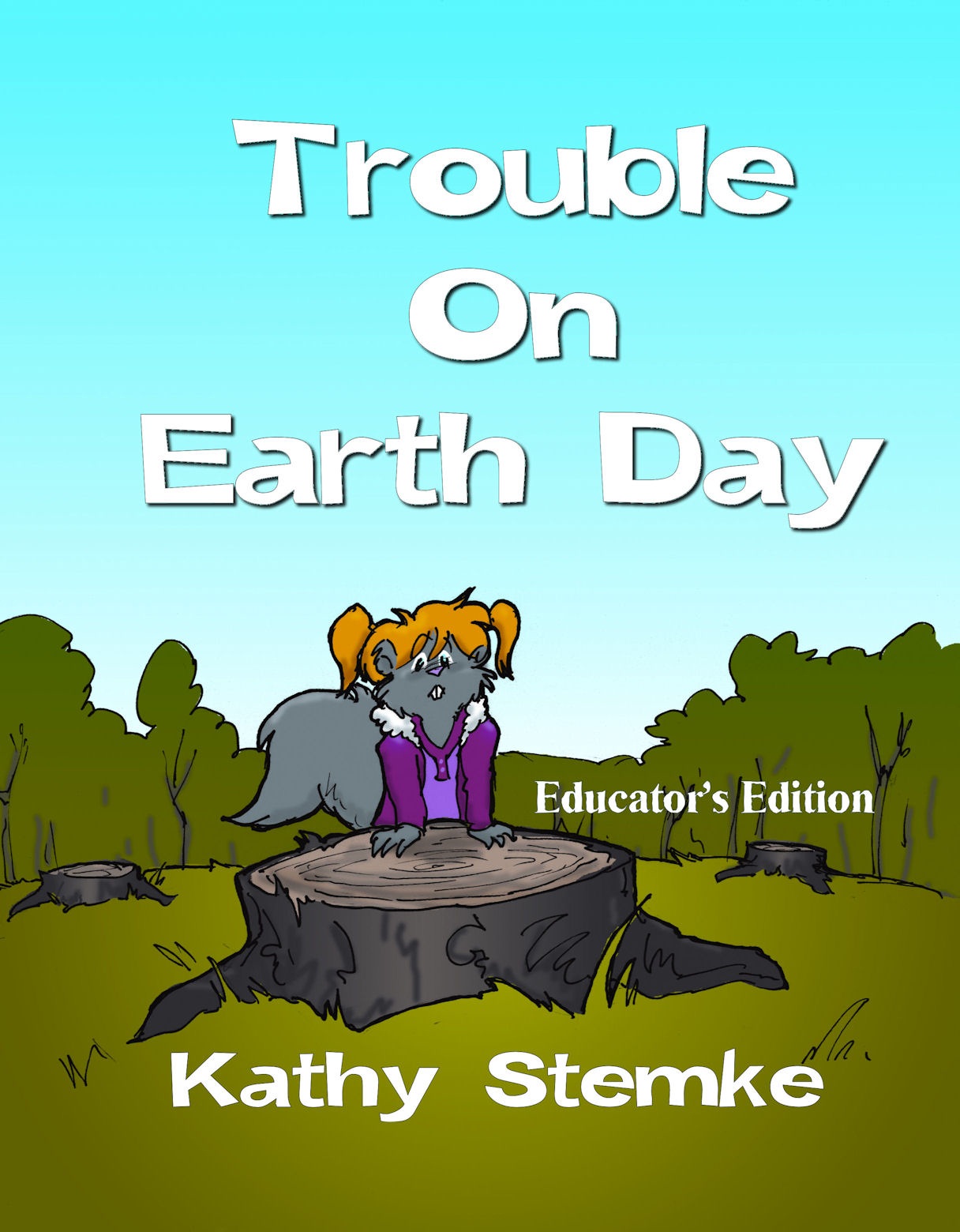
FIRST REVIEWS ARE IN FOR "TROUBLE ON EARTH DAY"


This is a fun story told from a squirrel's point of view on ways to celebrate Earth Day. It is chock full of recycling crafts to empower children to make a difference in their world. I liked the nylon sachets and the CD picture frames!

Patricia Karwatowicz
Children's author


There are zillions of books for kids about holidays like Thanksgiving and Christmas, but not nearly as many about Earth Day. Trouble on Earth Day by Kathy Stemke not only fills that void, it's also a delightful picture book that will encourage children to appreciate and care for our environment all year long.

The pictures and plot are cute and young kids will enjoy hearing the book read aloud to them. Older children can read it themselves and participate in the many educational activities suggested. This would be a great book to add to school libraries as well as for families.

Reviewed by Janet Collins
Children's author

Kathy Stemke's websites: Helium Education Articles: http://www.helium.com/users/406242.html Education Articles: http://www.associatedcontent.com/user/237923/Kathy_stemke_dancekam.html Follow me on twitter: http://twitter.com/kathystemke Follow me on Facebook: http://www.facebook.com/topic.php?uid=6147172660&topic=4910#!/kathymarescomatthews.stemke?ref=profile Follow me on LinkedIn: www.linkedin.com/pub/kathy-stemke/13/269/285
Monday, August 22, 2011

Prepare Your Older Children for a New Baby!


Sh Sh Sh Let the Baby Sleep is an ideal baby shower gift to help children adjust to a new baby in the home. This action packed picture book with fantastic illustrations will hold the attention of the youngest child while challanging the older sibling. The teacher supplement in the back includes, poems, songs, comprehension questions, activities and worksheets.
Having a baby is life-altering for you and everyone around you including your other children.  The key to a smooth transition is to have a plan for both preparing and training older siblings. Brainstorm before the child is born to come up with ways of coping with the situations that are bound to arise once the baby has arrived.
Prepare your child:
·         Tap into your child's natural curiosity about babies. Look at picture books together and talk about what's going on inside your body right now and what the baby will be like after birth.
·         If they are old enough to understand, tell them the baby is coming near a certain holiday.
·         Take your children with you to some prenatal meetings. Give them jobs to do like squirting the jelly on your belly. 
·         Let them decorate a one piece with fabric paint for the new baby.
·         Have them pick out some things for the baby's room.
·         Ask a friend or relative to give your child some extra time and attention after the baby arrives. This will help him know that he's still special.
Hover: Whenever the children are together, “hover” close by. If you see your child about to get rough, pick up the baby and distract the older sibling with a song, a toy, an activity or a snack. This action protects the baby while helping you avoid a constant string of “Nos,” which may actually encourage the aggressive behavior.
Teach soft touches: Teach the older sibling how to give the baby a back rub. Tell how this kind of touching calms the baby, and praise the older child for a job well done. This lesson teaches the child how to be physical with the baby in a positive way.
Act quickly: Every time you see your child hit, or act roughly with the baby, act quickly. You might firmly announce, “No hitting, time out.” Place the child in a time-out chair with the statement, “You can get up when you can use your hands in the right way.” Allow him to get right up if he wants – as long as he is careful and gentle with the baby. This isn’t punishment, after all. It’s just helping him learn that rough actions aren’t going to be permitted.
Demonstrate: Children learn what they live. Your older child will be watching as you handle the baby and learning from your actions. You are your child’s most important teacher. You are demonstrating in everything you do, and your child will learn most from watching you.
Praise: Whenever you see the older child touching the baby gently, make a positive comment. Make a big fuss about the important “older brother.” Hug and kiss your older child and tell him how proud you are.
Don't panic if your older one doesn't take to the newborn at first sight. Sibling love sometimes takes a while to blossom.  The keys to a smooth transition are to anticipate and empathize. "Everything will go much more smoothly if you can put yourself in another person's shoes.”

Kathy Stemke's websites: Helium Education Articles: http://www.helium.com/users/406242.html Education Articles: http://www.associatedcontent.com/user/237923/Kathy_stemke_dancekam.html Follow me on twitter: http://twitter.com/kathystemke
Follow me on Facebook: http://www.facebook.com/topic.php?uid=6147172660&topic=4910#!/kathymarescomatthews.stemke?ref=profile
Follow me on LinkedIn: www.linkedin.com/pub/kathy-stemke/13/269/285